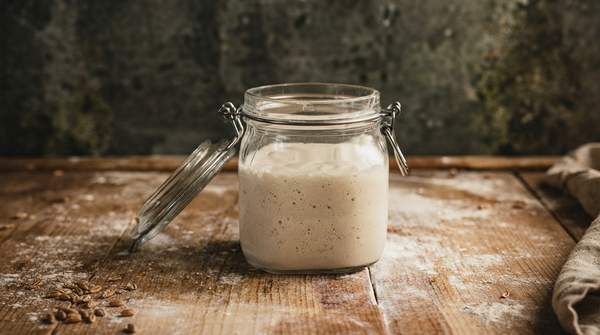
Most sourdough starter problems come down to three things you control: temperature, feeding ratio, and flour. A starter that barely rises is usually too cold or underfed; a starter that smells sharply sour or grows a layer of liquid is usually hungry and overly acidic. Once you can read those signals, you can pick a single, targeted adjustment instead of guessing. Here's how to diagnose what your starter is telling you—and the science behind each fix.
Understanding Your Sourdough Starter's Signals
Your starter talks to you every day, if you know what to look for. The clearest signal is rise: a healthy culture expands visibly after feeding, filled with bubbles from gas-producing fermentation. When that rise is sluggish or absent, something is suppressing the microbes. The other big signals are smell and surface liquid. A sharp, vinegar-like or acetone-like odor tells you the culture has fermented too far and become too acidic.
That dark or clear liquid on top deserves a closer look. According to The Sourdough Journey's troubleshooting guidance, it's either harmless water separation or "hooch"—ethyl alcohol, a natural byproduct of yeast fermentation. The distinction matters: if your starter has not risen and fallen, it's water separation; if it has completed a rise-and-fall cycle, it's hooch, a sign the starter has exhausted its food. Many new bakers mistake one for the other.
One reassuring note before we diagnose anything: starters are hard to kill. The Sourdough Journey's guidance is blunt about common accidents—chlorinated water, the wrong flour—"No. Resume your normal feeding process the next day." Even a 5% bleach solution experiment, they report, "I could not kill it." So before you consider drastic measures, try the adjustments below.
The Science of Sourdough: Yeast, Bacteria, and pH
A starter is a partnership between yeast and lactic acid bacteria (LAB). The yeast produces carbon dioxide that leavens your dough; the LAB produce organic acids that create sourness and shape flavor. The two populations are always competing for the same food, and the balance between them determines whether your starter rises vigorously, tastes pleasantly tangy, or collapses into acidity.
Acidity is the fulcrum. A scientific review of sourdough ecology published in a peer-reviewed journal notes that temperature influences "microbial dominance (bacteria vs. yeast), growth (cell density), and microbial activity (production of organic acid, volatiles, and CO2)." In other words, when conditions tilt toward the bacteria, acid accumulates, pH drops, and yeast activity suffers. The Sourdough Journey makes the practical corollary explicit: most weak starters are actually acidic starters. The yeast isn't missing—it's being suppressed by its own acidic environment.
That's why the fixes below work. Warming the culture, feeding it more generously, or introducing a more nutritious flour all shift the playing field back toward a balanced yeast-bacteria partnership.
Sourdough Starter Troubleshooting Framework
Use this table to match what you're seeing in your jar to the most likely microbial cause, then apply the single most effective change. Change one variable at a time so you can tell what actually worked.
| Symptom | Likely Cause (Microbial Balance) | Primary Solution | Why It Works |
|---|---|---|---|
| Sluggish or no rise | Cold has slowed yeast and bacteria, or the starter is underfed, leaving a weak population | Warm the starter's spot to roughly 75–80°F (24–27°C) and feed at a ratio like 1:2:2 | Higher temperature speeds microbial growth and gas production; more food supports a larger population |
| Strong sour or vinegar-like smell | Excess acidity—LAB have outproduced acid as food ran out, dropping pH and suppressing yeast | Feed more often and use a larger feeding ratio (between 1:2:2 and 1:5:5 rather than 1:1:1) | A bigger feeding dilutes accumulated acid and delivers fresh food before the culture starves |
| Layer of liquid ("hooch") on top after a rise-and-fall | The starter exhausted its flour and kept fermenting; hooch is ethyl alcohol from yeast fermentation | Pour off the hooch and feed promptly; shorten the interval between feedings | Hooch signals hunger—refeeding restores food before acidity climbs further |
| Clear liquid but no rise-and-fall occurred | Water separation, not hooch—harmless, often from under-mixing or hydration imbalance | Stir it back in and feed normally | No microbial problem to fix; consistency returns with normal feeding |
| Weak rise even when warm and fed | Flour isn't supplying enough nutrients or microbial diversity to sustain activity | Incorporate whole grain flour (such as whole wheat or rye) into feedings | Whole grains introduce more microorganisms and nutrients into the culture |
One boundary to keep in mind: this framework is for established starters, not brand-new ones still developing their ecology. And if you ever see mold or suspect harmful contamination, discard the starter—these adjustments won't fix that.
Control Variables Explained: Temperature, Feeding, and Flour
Every fix in the table above manipulates one of three levers. The sourdough research review identifies the most influential management factors as flour type, hydration, temperature, time, and re-feeding practices. For troubleshooting, the three you'll reach for most are temperature, feeding ratio, and flour composition—each shifts the yeast-bacteria balance in a predictable direction.
Temperature: Orchestrating Microbial Dominance
Temperature is the fastest lever you have. The research review confirms it drives microbial dominance, cell density, and the production of acid, aroma compounds, and CO2. Practically, that means a cold kitchen slows everything down: less gas, less rise, and a starter that looks dead when it's merely dormant. The Sourdough Journey's guidance flags cold as a leading reason starters stall.
Warmth does the opposite—it wakes the whole ecosystem. Aim for a spot in the mid-70s Fahrenheit (roughly 24–27°C) for peak activity. The flip side is real, too: warmer temperatures accelerate fermentation, so a starter kept warm will get hungry sooner and turn acidic faster if you don't match the warmth with adequate feeding. Temperature and feeding ratio work as a pair.
Feeding Ratios: Managing Hunger and Acidity
A feeding ratio like 1:2:2 means one part starter, two parts flour, two parts water. The size of that ratio controls how much food exists per microbe, and that determines how acidic the culture gets over a feeding cycle. Sourdough Explained's maintenance guidance is direct on this point: avoid 1:1:1 for ongoing maintenance, "as this will lead to an increase in acidity, which will affect performance of your starter, its ability to rise your dough and ultimately your bakes."
Why does a small ratio turn sour? With little fresh flour, the microbes consume everything quickly, and the LAB keep producing acid in a food-scarce, low-pH environment that favors them over yeast. A larger ratio—Sourdough Explained recommends anywhere between 1:2:2 and 1:5:5—dilutes accumulated acid and provides food for longer. Their seasonal advice: in a cold kitchen, stick to the lower end, like 1:2:2 or 1:3:3, because cold slows consumption and a big ratio would leave food unconsumed for too long. A 1:1:1 ratio still has its place—building a starter from scratch or preparing a levain—just not for daily maintenance.
Flour Type: Boosting Activity and Flavor
The third lever is what you feed with. The sourdough research review notes that flour type impacts the culture's ecology, its effectiveness as a leavening agent, and its sensory qualities—and importantly, that flour itself introduces microorganisms into the sourdough medium. LAB in nature are associated with plants, and generalist species are often the first colonizers of new starters, which is why flour choice shapes the community from the first day.
For a struggling starter, that means whole grain flours are a genuine intervention, not just a preference. Whole wheat and rye carry more of the grain's outer layers—more nutrients and more microbial input—so swapping a portion of white flour for whole grain gives a weak culture more to work with. If your starter is warm, well-fed at a healthy ratio, and still sluggish, changing the flour is the logical next move.
Achieving a Healthy, Active Starter
By systematically observing your starter's symptoms and adjusting temperature, feeding ratios, or flour type based on the underlying microbial science, you can consistently maintain a healthy and active culture. The method is simple: read the symptom, identify the imbalance, change one variable, and give the culture a few feeding cycles to respond before judging the result.
You'll know the fix worked by a measurable indicator: the sourdough starter exhibits numerous bubbles and has a mild, pleasant tangy aroma. That combination—visible gas production without harsh sourness—is the signature of a yeast population thriving in balance with its bacteria. When you see it after a feeding, your starter is ready to leaven bread again. If the sharp smell creeps back, shorten your feeding interval; if the rise fades, check the temperature first. The signals will always tell you which lever to pull next.