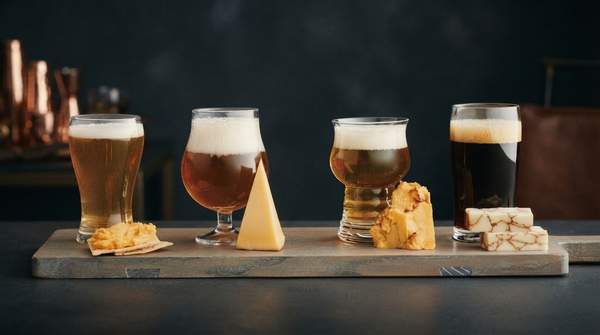
Yes, you can put the wine list aside. Beer and cheese share centuries of farmhouse history, and some of the most delightful pairings are the ones that sound wrong on paper—a salty blue against a sweet stout, briny feta beside a sour fruit beer. The specialists at Cheese Grotto, who build pairing guides around matching and contrasting cheese flavors with beer styles, lay out a small set of recommendations that break the usual "stout with cheddar" habits. Below are five of those unexpected combinations, plus the flavor principles behind them, so you can start inventing pairings of your own with real confidence.
Unexpected Beer & Cheese Pairings for Sophisticated Palates
Before we get to the principles, let's look at the pairings themselves. All five come from Cheese Grotto's beer and cheese pairing guidance, and each one pairs a cheese with a beer most people would never think to pour alongside it. Read the middle column as the surprise and the final column as the logic: once you see the pattern—sweet against salty, funk against funk, fruit against brine—you can swap in your own cheeses and beers with confidence. One honest caveat up front: these are expert recommendations from published guides rather than independently tested results, so treat them as a starting point for your own tasting, not a guarantee.
Unexpected Cheese & Beer Pairings Explained
| Cheese Type | Unexpected Beverage Pairing | Primary Flavor Interaction | Why It Works |
|---|---|---|---|
| Salty blue cheese | Sweet, full-flavored stout or porter | Contrast: salty vs. sweet | The sweetness of the beer balances the pronounced saltiness of the blue cheese. |
| Salty blue cheese | Spice-infused Christmas ale or pumpkin beer | Contrast: salty vs. sweet and spiced | The seasonal spice and sweetness counterweight the cheese's salt intensity. |
| Funky washed-rind cheese | Rustic farmhouse ale or saison | Similarity: funk meets funk | The rustic, earthy, wild-fermented notes of the beer mirror the pungent, yeasty character of the washed rind. |
| Salty feta | Fruit-forward gose | Contrast and cut: fruit and acidity vs. salt | The beer's fruitiness and acidity cut through and balance the cheese's saltiness—think a feta-centric mezze platter. |
| Salty feta | Fruit-forward kriek | Contrast and cut: fruit and acidity vs. salt | Same logic as the gose: the sour cherry fruitiness refreshes the palate against salty feta in a salad or spread. |
The pairings Cheese Grotto singles out are pleasingly specific. Washed rinds like Consider Bardwell's Pawlet or Ruby, or Green Dirt's plush washed rind, belong with farmhouse ales, saisons, or other wild-fermented beers. The feta suggestions lean toward a fruit-forward gose or kriek served alongside a mezze platter or salad. Those concrete anchors matter, because they show the principle isn't abstract—the beer is chosen to answer something the cheese is already doing on the plate.
Notice, too, how the table sorts itself. Three of the five rows are contrast pairings and one is a similarity pairing, which tells you something important: the "unexpected" factor in these matches comes almost entirely from opposition. Nobody blinks at funk-with-funk; everyone blinks at sweet-beer-with-salty-cheese. That asymmetry is where the adventure lives, and it's why the contrast rows deserve the most attention from anyone hoping to surprise guests.
The Three Principles Behind Every Great Pairing
Look back at the table and you'll see it's really a lesson in two moves that Cheese Grotto makes explicit: mirroring and contrasting. The washed-rind row is pure mirroring. A funky, yeasty, pungent cheese finds its echo in a rustic, wild-fermented saison—the two share earthy, barnyard-adjacent notes, so they amplify each other rather than compete. That's the similarity principle: pair cheeses and beers that speak the same dialect of funk, yeast, or earth.
The other rows are contrast, and contrast works in two distinct ways. Blue cheese is loud with salt, so Cheese Grotto recommends something sweet and full-flavored—stout, porter, even a spice-infused Christmas ale or pumpkin beer—so the sweetness has enough body to stand up to it. This is contrast as balance: the beer supplies the element the cheese lacks, and neither overwhelms the other.
Feta gets a different treatment. Instead of matching weight, you cut through it. The fruitiness and acidity of a gose or kriek slice through the salt and reset your palate between bites. Same principle, different mechanism—one sweetens the salt, the other refreshes it. Call that third move synergy: the combination creates an effect neither element achieves alone, the way acidity makes the next bite of feta taste brighter than the first one did.
Put simply: when a cheese has a dominant trait, you have two choices. You can echo it with a beer that shares the same character, as with funky washed rinds and wild-fermented ales, or you can oppose it with a beer that offers the missing element—sweetness for salty blues, fruit and acidity for briny feta. Neither move is better; they just suit different cheeses. This is also why these pairings feel unexpected: our instincts say "match like with like," and the surprise is how well opposition works.
There's a practical test hiding in that framework. Before you pour anything, ask yourself one question about the cheese in front of you: what is its loudest quality? If the answer is funk, reach for a beer that echoes it. If the answer is salt, reach for a beer that opposes it—sweet and rich if the cheese is intense like a blue, fruity and acidic if the cheese is fresh and briny like feta. That single question converts a shelf of intimidating beer styles into a short, manageable list of candidates.
One more honest caveat: these combinations come from expert guides, not from controlled tasting panels, and this article covers beer rather than every beverage a cheese could meet. If you serve a gose with a mild, buttery brie instead of salty feta, you're off the map the evidence supports—though the acid-versus-salt logic suggests it's a fair experiment. The point of learning the principles is precisely that you can run that experiment yourself, with a hypothesis about why it might work.
Your Next Pairing Adventure
Here's your decision point: experiment with new cheese and beverage pairings by applying the principles of contrast, similarity, and synergy. Start with any of the five rows above—say, a wedge of feta with a fruit-forward kriek—then change one variable at a time: swap the kriek for a gose, or the feta for a blue. Taste deliberately after each change and ask yourself which principle you just exercised, mirroring or opposing. Did the sweetness soften the salt, or did the acidity reset your palate? Naming the mechanism is what turns a lucky match into a repeatable skill.
The measurable indicator of success is straightforward: the successful discovery of a personally enjoyable, unexpected cheese and beverage combination. When you find one that surprises your guests as much as it pleases you—one you'd serve again at your next gathering—you've graduated from following pairing recipes to trusting pairing instincts. That's the real payoff: not five pairings memorized, but a framework that keeps generating new ones every time you face a cheese counter and a beer list together.
Sources
- How to Pair Cheese and Beer — Cheese Grotto