Here's the short answer to how sourdough and kombucha starters create flavor: both are living microbial ecosystems, and the flavors you taste are the metabolic byproducts of the bacteria and yeasts living in them. But the two systems behave very differently when you try to control them. Sourdough is a partnership you can steer — change the flour you feed it, and you reliably change the bacteria, and with them the aroma and taste. Kombucha, fermented by a SCOBY, is far more variable, and scientists haven't even reached a consensus on which species are essential to it. Let me walk you through why, and what it means at your counter.
The Microbial Architects of Flavor: Sourdough vs. Kombucha
Every fermentation starter is really a tiny, crowded city. The residents — bacteria and yeasts — eat the food you supply and produce acids, gases, and aromatic compounds as waste. Those byproducts are what your tongue and nose register as flavor. As microbiologist Justine Dees explains in her overview of the sourdough microbiome, the live microorganisms inhabiting a starter are responsible for the unique character of sourdough bread, including its flavor.
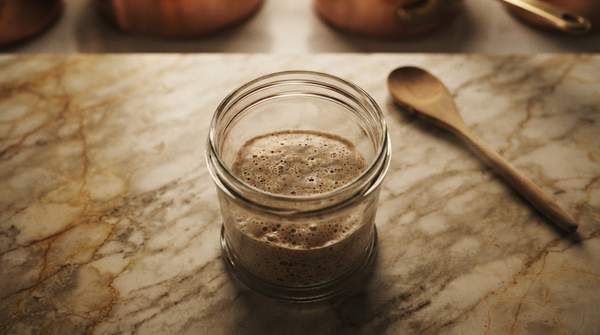
The two cities we're comparing are built on different foundations. A sourdough starter is just flour and water, inoculated by microbes naturally occurring in the flour and propagated through repeated feeding. Kombucha, by contrast, is a sweetened tea fermented by a SCOBY — a symbiotic culture of bacteria and yeasts. Same broad principle, very different residents, and — as you'll see — very different levels of control for you as the fermenter.
Sourdough: A Predictable Partnership of Flour and Microbes
Sourdough is the more orderly of the two worlds. Microbiologically, it's an environment with low pH, high carbohydrate concentration, limited oxygen, and lactic acid bacteria outnumbering yeasts, as researchers reviewing sourdough fermentation describe it. It's a rich habitat: a starter can support more than 50 species of lactic acid bacteria and more than 20 species of yeasts.
Here's the part that matters for you: the flour you choose is a flavor dial. A 2023 study from NC State, led by researcher Erin McKenney, analyzed 40 starters grown from 10 types of flour over 14 days and found that "using different types of flour fosters distinct bacterial communities, and that these differences contribute to the variation of sourdough aromas and flavors." The study, published in PeerJ, identified six distinct stages of microbial succession, and at each stage the bacterial taxa correlated with determinants of bread quality including pH, rise, and aromatic profile. Day-one cultures, for instance, were dominated by microbes commonly associated with plants and flour, with aromas similar to toasted grain.
That's the key insight: the relationship between flour type and flavor is well-documented, with bacterial diversity and associated aromas changing predictably over time. You're not guessing — you're steering.
Kombucha: A Dynamic Ecosystem with Variable Outcomes
Kombucha flips that script. Its SCOBY is dominated by acetic acid bacteria and yeasts, with lactic acid bacteria also frequently present, and it ferments sweetened tea into the finished drink. But while sourdough science has mapped a predictable path from input to aroma, kombucha research is still finding its footing.
A study of SCOBY starter cultures used by commercial North American kombucha brewers, published in a peer-reviewed microbiology journal, notes that although DNA sequencing has given researchers a more detailed view of SCOBY composition than earlier methods, these techniques "have not facilitated establishment of a consensus view of Kombucha ecology." The same paper observes a greater degree of apparent interchangeability in the dominant yeast and bacterial species across kombucha cultures — meaning the cast of microbes seems to matter less rigidly than in sourdough, and which species are truly essential remains unsettled.
There's even a practical research hurdle: the SCOBY is a cellulosic solid, and the authors point out that adequately sampling this material is a significant challenge, with very few studies even describing their sampling scheme. For you, the practical translation is simple: with kombucha, consistent inputs don't guarantee a specific, repeatable flavor outcome the way consistent flour choices do in sourdough.
Sourdough vs. Kombucha: A Flavor Control Framework
Use this table to see, at a glance, why one starter responds to your choices more readily than the other — and what that means for your next batch.
| Dimension | Sourdough Starter | Kombucha SCOBY |
|---|---|---|
| Primary microbes (general categories) | Lactic acid bacteria (LAB) and yeasts; a starter can support more than 50 LAB species and more than 20 yeast species | Dominated by acetic acid bacteria (AAB) and yeasts, with LAB also frequently present |
| Key flavor influences (substrate) | Flour and water; flour type demonstrably shapes the bacterial community and its aromas | Sweetened tea; the SCOBY metabolizes these inputs into the beverage |
| Flavor predictability | High — flour choice predictably shifts bacterial communities, aromas, and taste over defined stages of succession | Lower — research shows apparent interchangeability of dominant species and no consensus on which are essential, so specific outcomes are harder to target |
The comparison comes down to this: in sourdough, the evidence links a controllable input (flour) to a measurable shift in the microbial community and its aromatic output. In kombucha, the microbial community itself is less pinned down, so the path from input to flavor is murkier.
Shared Microbes, Shared Potential: The Overlap in Fermentation
So what happens when people do something playful — like feeding a sourdough starter with kombucha? The experiment isn't as strange as it sounds, and the science explains why. Both cultures run on the same broad categories of microorganisms: lactic acid bacteria and yeasts. Sourdough is fermented by LAB and yeasts naturally occurring in the flour; kombucha's SCOBY contains yeasts and acetic acid bacteria alongside lactic acid bacteria.
That shared microbial vocabulary is why the two starters can, in principle, interact at all. The overlap allows for the introduction of additional microbial activity and the potential for flavor and texture improvements when combined — though I'd frame any single home experiment as exactly that: an experiment, not a guaranteed outcome. The kombucha side of the blend brings its own variability with it, so treat the result as an exploration rather than a recipe.
Empowering Your Fermentation Journey
Here's your decision framework: home fermenters can predictably influence sourdough flavor by experimenting with different flour types, while kombucha offers a more variable, less directly controllable flavor profile. If you want to steer flavor with confidence, work the sourdough side of your counter; if you enjoy surprise, brew kombucha.
Your measurable indicator: observe changes in sourdough aroma and taste when using different flours, and recognize the inherent variability in kombucha flavor outcomes despite consistent inputs. A concrete starting point comes straight from the NC State study design — grow parallel starters from two or more different flours over 14 days and compare how their aromas diverge. Note that early starters smell like toasted grain; track how each flour's aroma shifts across the days. That side-by-side comparison is your proof that the flour dial works — and it's the same evidence pattern the researchers themselves used.
Sources
- The Sourdough Microbiome — ASM
- Sourdough Microbiome Comparison and Benefits - PMC
- Using Different Flours for Sourdough Fosters Different Bacteria – and Flavors — NC State News
- Microbial Composition of SCOBY Starter Cultures Used by Commercial Kombucha Brewers in North America - PMC
- Frontiers | Role of lactic acid bacteria and yeasts in sourdough fermentation…