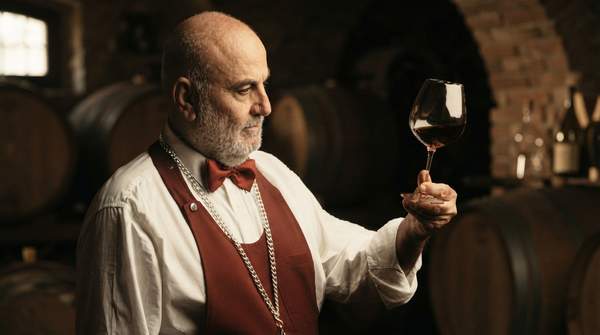
Sommelier language isn't a secret code—it's a practical toolkit organized around how you actually experience wine: what you smell, how it feels, how it tastes, and how long it lingers. Master the handful of terms that describe aroma, body, acidity, sweetness, tannin, and finish, and you can move beyond "I like this one" to describing precisely why. This guide groups the most essential vocabulary by the sensory characteristic each word describes, mirroring the structured approach professionals use when they evaluate a glass.
The Sommelier's World: Language as a Tool
A sommelier is a trained and knowledgeable wine professional, often working in fine-dining restaurants, as the Vineyard Market's beginner guide puts it. The title sits atop a progression of certifications, with Master Sommelier described in that same guide as "the pinnacle of the profession, requiring exceptional skill in all areas of wine service, tasting, and theory." In practice, that means curating wine lists, guiding guests toward bottles they'll enjoy, and evaluating wine with consistency.
That evaluation often happens through blind tasting—sampling wines without knowing their identity to eliminate bias—which the Vineyard Market calls a valuable skill for honing the ability to discern and describe wines based purely on sensory experience. The Court of Master Sommeliers Americas formalizes this in its Deductive Tasting Format, a structured grid that moves from sight (clarity, color intensity) to nose (aromatic intensity, fruit character) to palate, ending in a reasoned conclusion about the wine's identity.
The vocabulary exists because precision matters professionally. As Master Sommelier Scott Carney, Dean of Wine Studies at the Institute of Culinary Education, writes, "Developing a wine tasting vocabulary is a vital aspect of wine education and an essential skill for many careers in the beverage industry." He compares it to the specialized terminology of fine art and music reviews—initially arcane to novices, but learnable.
Decoding Wine Aromas: What You Smell
Aroma is simply what the wine smells like, and according to the Court of Master Sommeliers Americas, those smells come mostly from the grapes, but also from how the wine was made and what it was aged in. That last part explains one of the most common terms you'll encounter: oaky. The Sommeliers Choice Awards glossary defines an oaky wine as one with a noticeable perception of oak barrel aging, denoting smells of vanilla, baking spices, and dill, often with a creamy body and toasted flavor.
Other aroma terms point to the fruit itself or its condition. Spicy describes wines with the flavor and aroma of spices such as cloves, thyme, black pepper, bay leaf, or paprika. Vegetal flags characteristics of cooked vegetables detected on both the nose and the palate—the glossary notes it as an undesirable quality produced from unripe grapes. A wine described as reticent holds back and doesn't exhibit its expected aromas due to youth, while an open wine is ready to drink and showing what it has.
Notice that these words describe categories of scent, not specific bottles. When a sommelier says "baking spices" or "cooked vegetables," they're giving you a recognizable reference point—much like the Deductive Tasting Format's nose section, which asks candidates to identify fruit character and aromatic intensity on a scale from delicate to powerful.
Understanding the Palate: Taste, Texture, and Structure
Once the wine is in your mouth, four structural concepts do most of the descriptive work, and confusing them is the most common beginner mistake. Body is how full or light the wine feels, ranging—as the Court of Master Sommeliers Americas puts it—from watery to as rich as cream, with alcohol and residual sugar usually driving that weight. Crucially, body is a textural sensation, distinct from flavor or sweetness.
Acidity is what makes your mouth water and gives a wine its lift, in the Court's phrasing. The Sommeliers Choice Awards glossary likens high acidity to a squirt of lemon—zesty, sharp-edged, sometimes sour—and a wine prominent in acidity may be called steely. Acidity is a key component of structure and can be described as low, medium, or high.
Sweetness indicates the level of residual sugar: dry wines have no noticeable sugar, off-dry wines a little, and sweet wines a noticeable amount. It's perceived on the palate and is distinct from fruitiness—a fruity dry wine can taste ripe without being sweet. Tannin, finally, is the drying, astringent grip you notice mostly in reds; a rough wine is a young tannic one with a coarse texture, while smooth and silky describe wines with soft tannins and pleasing texture. Tannins contribute to structure and can be described as soft, firm, or aggressive.
Essential Sommelier Terms by Sensory Category
Use this table during a tasting: identify the sensation you're experiencing—smell, weight, tartness, sweetness, grip, or persistence—then find the professional term that matches it. The framework distinguishes concepts that beginners often blur, such as body versus sweetness, or acidity versus bitterness.
| Sensory category | Term | Definition | Example sensation |
|---|---|---|---|
| Aroma | Oaky | Noticeable perception of oak barrel aging; smells of vanilla, baking spices, and dill, often with creamy body and toasted flavor | Vanilla and toast rising from the glass |
| Aroma | Vegetal | Cooked-vegetable characteristics on nose and palate; an undesirable quality from unripe grapes | Boiled cabbage or asparagus notes |
| Aroma | Spicy | Flavor and aroma of spices such as cloves, thyme, black pepper, bay leaf, or paprika | Black pepper on the nose |
| Body | Full-bodied | Feels rich, weighty, and substantial in the mouth; alcohol and residual sugar usually drive the weight | Cream-like richness rather than watery lightness |
| Acidity | Acidic / Steely | Noticeable tartness or crispness that makes your mouth water and gives the wine lift; can be low, medium, or high | A squirt of lemon; a sharp, zesty edge |
| Sweetness | Dry to sweet | The level of residual sugar—dry (none noticeable), off-dry (a little), sweet (noticeable); distinct from fruitiness | Ripe fruit flavors in a wine with no perceptible sugar |
| Tannin | Tannic / Smooth | Drying, astringent grip, mainly in reds; soft tannins feel smooth and silky, young coarse tannins feel rough | Grip on the gums versus a silky, velvety texture |
| Finish | Lingering finish | Flavors and sensations that persist after swallowing; a long, pleasant finish is generally a positive attribute | Flavors still present many seconds after the sip |
One caveat worth keeping in mind: while this framework aids understanding, the precise sensory perception and interpretation of these terms can be subjective. Two experienced tasters can weigh a wine's acidity differently, and modern wine conversation keeps evolving—so treat these definitions as shared reference points, not rigid laws.
The Lingering Impression: Describing the Finish
The finish is what remains after the wine has been swallowed, and it's where structure and flavor converge. According to the Vineyard Market's guide, a long, complex finish is often a sign of a high-quality wine, while a short finish may indicate a simpler one—and the finish itself can be fruity, spicy, or even earthy in character.
This is why professionals linger over a wine rather than moving on immediately. The Deductive Tasting Format treats the palate's conclusion as evidence: what persists, how it persists, and whether the persistence is pleasant all feed into the final assessment. For you, the practical move is simple—after swallowing, count roughly how long the flavors stay with you and note their character. "A long, spicy finish" tells a sommelier far more than "it was good."
Applying the Vocabulary: From Tasting to Articulation
Here's how to put the framework to work at your next tasting. Smell first and pick an aroma word: is it oaky, spicy, vegetal, or simply fruity? Then sip and assess structure in order—weight (light or full?), acidity (does your mouth water?), sweetness (any perceptible sugar?), and, for reds, tannin (gripping or silky?). Finally, wait and describe the finish before reaching any verdict.
Working through the categories systematically does two things. It sharpens your own perception, because naming a sensation forces you to notice it. And it makes you legible to professionals: telling a restaurant sommelier you enjoy "full-bodied whites with high acidity and a long finish" will get you a better recommendation than "something dry but not too dry."
Remember the boundaries of this guide. It covers tasting and descriptive vocabulary, not winemaking, grape growing, or regional terminology, and it's a curated set of essentials rather than an exhaustive dictionary. It also won't tell you which wine to buy—that's what the vocabulary is for.
Empowering Your Wine Journey: Speak Like a Sommelier
Readers should actively practice using the structured vocabulary presented to describe wines, moving beyond simple "like" or "dislike" to articulate specific sensory experiences. The measurable indicator of success is straightforward: the reader can confidently use at least one term from each sensory category—Aroma, Body, Acidity, and Finish—when describing a wine to a friend or professional, and understand the meaning of these terms when encountered in wine descriptions. Open your next bottle, work through the four categories in order, and see whether the words don't come more easily than they ever have before.
Sources
- Sommelier 101: Wine Terms for Dummies - Vineyard Market
- How to Describe Wine: Learn To Do It Like a Pro — The Court of Master Sommeliers Americas
- Wine Terms & Wine Education — ICE
- Glossary of Wine Tasting Terms And Their Meaning — Sommeliers Choice Awards
- Mastersommeliers