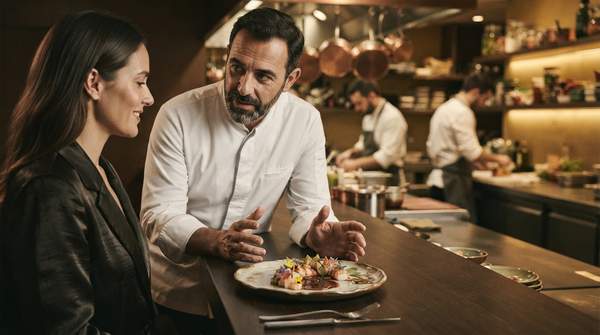
The chef's table is not one experience but several. Across restaurants recognized by the Michelin Guide, the concept takes radically different forms: a hidden speakeasy room in Madrid, a historic vault beneath Old Québec, and a private dining space buried inside a working kitchen in Hong Kong. Comparing three of them side by side shows how setting, menu structure, and chef engagement each shape the evening in distinct ways.
Introduction: The Allure of the Chef's Table
Part of the pleasure of dining out, as the Michelin Guide itself puts it, is discovering the magic behind the food. A chef's table strips away the distance between kitchen and guest, turning a meal into a front-row view of a working brigade. It is also a shifting concept: the Guide notes that what was once tied explicitly to a single eponymous head chef is trending toward celebrating the entire culinary team, with chefs "tag-teaming the table and introducing their contributions to the multi-course meal."
Ramón Freixa Atelier: The Speakeasy-Style Culinary Journey
In Madrid, a discreet door in the downstairs dining room of Ramón Freixa Tradición leads to the restaurant's atelier space. There, up to 10 guests gather around a U-shaped wooden table for one of two tasting menus: Origen or Origen Vegetalia. The setting feels like a hidden cocktail lounge repurposed for fine dining — intimate, enclosed, deliberately secret. Throughout the service, the chef pays tribute to his family roots, honoring his grandparents' background as bakers and his parents' as restaurateurs.
Tanière3: Intimacy in Historic Vaults
La Tanière³ sits within the historic vaults of Petit Champlain in Old Québec — an underground space the restaurant describes as "a place outside of time," where each meal becomes a sensory immersion. The restaurant offers two ways in: a dining room cellar billed as an intimate space that immerses the senses, and a chef's counter cellar that grants access to chef François-Emmanuel Nicol's universe, letting guests witness the brigade at work firsthand. Michelin's coverage of the Québec Guide selection describes the chefs moving between the kitchen and tables, with a single set menu — available in regular and vegetarian versions — spotlighting ingredients from Québec's terroir, such as Gaspé Peninsula halibut with carrot and agastache.
The Krug Room: A Bespoke Kitchen Immersion
The Krug Room offers perhaps the most literal version of the chef's table: a private, intimate room hidden within the kitchen of Amber at The Landmark Mandarin Oriental in Hong Kong. Here the point is proximity — not just to the food but to the people making it, with courses often prepared by the head chef. The menu is bespoke, built around the guests rather than a fixed structure, and the interaction is woven through the service itself.
Chef's Table Experience Comparison
Setting these three restaurants against the same dimensions — where you sit, what you eat, and how the kitchen engages you — reveals three distinct models of the same idea. The comparison below draws on the Michelin Guide's descriptions of each venue alongside Tanière³'s own presentation of its cellar experiences.
| Restaurant | Setting / Atmosphere | Menu Format | Chef Interaction Style |
|---|---|---|---|
| Ramón Freixa Atelier (Madrid) | Speakeasy-style atelier reached through a hidden door; intimate, enclosed environment | Two tasting menus, Origen or Origen Vegetalia, served to up to 10 guests; predefined with a vegetarian alternative | Chef works from the center of the U-shaped table, which becomes an extension of his kitchen — a central performer |
| Tanière³ (Québec City) | Historic vaults of Petit Champlain; intimate underground cellars, with a chef's counter facing the brigade | Single set menu in regular and vegetarian versions, fixed and focused on Québec's terroir and season | Chefs move between kitchen and tables — conversational, integrated into the dining flow |
| The Krug Room (Hong Kong) | Private room hidden inside the kitchen of Amber at The Landmark Mandarin Oriental — a behind-the-scenes immersion | Bespoke multi-course menu, customized to the guests' preferences, often prepared by the head chef | Chefs present each course, discuss pairings, answer questions and chat with guests — direct and playful |
The trade-offs are clear: Freixa's atelier offers theater with a fixed script, Tanière³ offers immersion with a communal, conversational rhythm, and the Krug Room offers exclusivity with a menu built around you rather than around the restaurant.
Understanding Chef Interaction Styles
"Chef interaction" means very different things at each of these tables. At Ramón Freixa Atelier, the chef occupies the center of the U-shaped table — the geometry itself makes him the focal point of the room. At Tanière³, interaction is mobile and conversational: the chefs circulate between the kitchen and the tables rather than holding court from a fixed spot. At the Krug Room, the chefs present each course, discuss the pairing, answer questions and, in the words of one of its chefs, "have a bit of fun, be playful and get some banter going with the guests."
These are genuine philosophical differences, not just levels of the same thing. Freixa's model is closer to a performance with the diner as audience; Tanière³'s is closer to being personally invited into someone's culinary home; the Krug Room's is a guided, bespoke conversation. None is objectively better — each suits a different diner.
Choosing Your Ideal Immersive Dining Experience
Select a chef's table experience based on your preference for a speakeasy-style setting with a central chef, an intimate historic vault with conversational chefs, or a private kitchen immersion with a bespoke menu and direct chef guidance. If you want the chef as performer and don't mind a predefined tasting menu, Madrid's atelier is the model. If you prefer chefs who drift to your table and a menu rooted in a specific place, Québec's vaults deliver that. If a menu built around your own tastes and maximum kitchen proximity matter most, the Krug Room's format is the match.
The measure of a good choice here is simple: before booking any chef's table, you should be able to say which style — performer-led, conversational, or bespoke-guided — aligns with the atmosphere and level of interaction you actually want, and pick accordingly. All three are drawn from the Michelin Guide's descriptions of the experiences rather than firsthand reviews, and none of this covers current pricing or availability, so confirm those details directly with the restaurants before you commit.