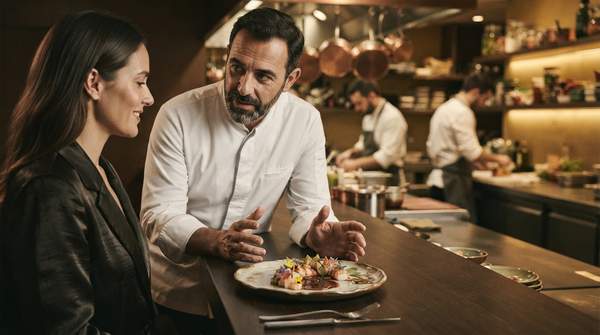
The chef commanding today's tasting counter — part artist, part executive, part television personality — occupies a role that barely existed three centuries ago. The modern fine dining chef was built in three broad stages: first as skilled domestic staff serving aristocrats in private households, then as a public professional working in restaurants open to anyone who could pay, and finally as a business leader and public figure whose influence extends well beyond the kitchen pass. The pivotal turning point came in the late 19th century, when Auguste Escoffier imposed military-style order on chaotic restaurant kitchens through his brigade de cuisine system. This story is drawn from the Western, particularly French-influenced, tradition of fine dining.
From Private Kitchens to Public Dining: The Chef's Early Evolution
Before the modern restaurant existed, fine dining was a private affair. As culinary school accounts describe, it was a highly exclusive pursuit reserved for aristocrats, who could afford to devote six hours of their day to a meal. The cook was a servant, and the idea that great cuisine could be served quickly and cost-effectively to large groups of paying customers did not become mainstream until the 1800s. The position of chef de cuisine — literally, chief of the kitchen — carried the authority of a craftsman, but only within a noble household.
The shift from private service to the public sphere took years, not a single moment. Antoine Beauvilliers illustrates the bridge between the two worlds: according to the encyclopedia account of the profession, he worked for numerous noble houses but eventually moved to Paris, opened the early fine dining restaurant La Grande Taverne de Londres, and wrote a cookbook, L'Art du cuisinier, in 1814. Chefs who made this transition carried the refined techniques of aristocratic kitchens out to a paying public, and the 19th century saw a flourishing restaurant culture in France, with prestigious establishments and the birth of the restaurant guide.
Timeline: The Evolving Role of the Fine Dining Chef
The chronology below organizes the profession's development into distinct eras, showing how each stage set the conditions for the next. Read down the timeline to trace the cause-and-effect progression: private wealth created the skills, public restaurants created the market, and systematization created the modern profession.
| Era | Key Developments | Pivotal Figures |
|---|---|---|
| Pre-Restaurant Era (pre-18th century) | Fine dining was exclusive to aristocrats in private households, with chefs working as skilled domestic staff — a period that predates the modern public restaurant concept. | Noble-house cooks; women worked as domestic cooks throughout Europe but were defined as servants |
| Late 18th – early 19th century | Public restaurants emerged, shifting the chef's role from private service to public restaurateur — a transition that evolved over decades. | Antoine Beauvilliers, who opened La Grande Taverne de Londres after serving noble houses |
| 19th century | Foundations of French gastronomy were laid, with cooking techniques codified and the grandes sauces established as the basis of classic haute cuisine. | Marie-Antoine Carême; earlier, François Pierre La Varenne |
| Late 19th – early 20th century | Chaotic kitchens were transformed into structured, professional operations through the brigade de cuisine, inspired by military hierarchy. Carême's classifications were refined into five Mother Sauces, and Le Guide Culinaire (1903) became a foundational text of culinary education. | Auguste Escoffier — the first renowned chef de cuisine trained and working only in public restaurants |
| 20th – 21st century | The chef's role expanded beyond cooking into business management, restaurant promotion, and media presence, with chefs managing financial matters and public relations. | Public-facing chef-entrepreneurs and restaurateurs |
Notably, the encyclopedia account of the profession records that no evidence exists of women being appointed chefs de cuisine in any kitchen setting until well into the twentieth century, even though women had worked as domestic cooks throughout Europe since the medieval period — a reminder that this professional ascent was, for most of its history, restricted.
The Systematization of the Kitchen: Carême and Escoffier's Legacy
The systematized profession that modern diners take for granted rests on two French figures. Marie-Antoine Carême codified the key sauces — the grandes sauces, in his phrase — on which classic French haute cuisine is based. His recipes for Velouté, Béchamel, Allemande, and Espagnole became standard for French chefs of his day, and though his elaborate, decorative style was aimed at the elite, his classifications were retained, with modifications, by later chefs. He created the grammar; someone still had to write the operating manual.
That was Escoffier's work. Working from the 1860s to the 1930s, he spent decades leading kitchens in grand hotels such as the Carlton. The kitchen he inherited was, in one culinary writer's description, chaotic, and Escoffier transformed these 19th-century restaurant kitchens into structured, professional operations with clearly defined roles. His brigade de cuisine divided the kitchen into specialized stations — the saucier, the pâtissier, the poissonnier, each under the leadership of a chef de cuisine — improving efficiency, consistency, and accountability. The system even formalized the pass: the aboyeur ensured each correct dish reached the correct table at the correct moment, so an entire course arrived together rather than in pieces.
Escoffier also completed what Carême began. He simplified Carême's detailed sauce classifications into five Mother Sauces — Béchamel, Velouté, Espagnole, Hollandaise, and Tomato — because, as accounts of his work relate, he believed the grandeur of French cuisine came from its sauces. In 1903 he published Le Guide Culinaire, which codified classical recipes and remains a foundational text of culinary education, with over 5,000 recipes. His reputation among contemporaries was such that the German Kaiser reportedly told him, "I am the Emperor of Germany, but you are the Emperor of Chefs." The point is not the anecdote but what it signals: by Escoffier's era, the chef himself had become a figure of public renown.
The Modern Chef: Beyond the Kitchen Pass
Once restaurants became part of the economic culture, the chef's job description stretched past the stove. As the encyclopedia account of the profession puts it, chefs de cuisine were as often found outside the kitchen — promoting their restaurants, dealing with customers, and reading and responding to profit and loss statements. The traditional tasks of overseeing menu and recipe development and supervising food production remained vital, but no longer encompassed the whole job. Escoffier had professionalized the craft; the restaurant economy then demanded that its leading professionals also become managers and marketers.
The American experience shows how tied the chef-restaurateur's fate became to broader commercial forces. Food historian David S. Shields profiles Louis Sherry, described as among the greatest early twentieth-century American restaurateurs, whose Manhattan restaurant closed in 1919: Prohibition undermined the revenue from wine and liquor sales on which haute cuisine financially rested, and Sherry abandoned hospitality to become a commercial confectioner. Fine dining's leaders were now fully exposed to the market — a position Escoffier's generation had helped create.
That exposure is the through-line of the profession's history. The aristocrat's cook answered to one palate; the restaurateur answers to a market; the modern chef-entrepreneur answers to a market plus a brand. Each stage inherited the last: Carême's codified sauces gave Escoffier a system to refine, Escoffier's brigade gave restaurants the capacity to operate at scale, and operating at scale gave chefs the platform — and the obligation — to become public figures.
Understanding the Modern Chef's Influence
Discerning diners can better appreciate contemporary restaurant culture by recognizing the historical journey of the chef, from a skilled artisan in private service to a multifaceted culinary leader, business manager, and public figure. The chef behind your tasting menu is the product of that evolution — carrying Carême's sauces, Escoffier's hierarchy, and a restaurateur's ledger simultaneously.
The clearest indicator that this transformation endures is the continued prominence of chefs in media, restaurant branding, and culinary education, reflecting their expanded influence beyond the kitchen. When the next chef appears on a magazine cover, fronts a restaurant's brand, or publishes a codifying cookbook, you are watching the latest entry in a timeline that began with an unnamed cook in a noble house — and reached its public form when Escoffier proved the kitchen itself could be engineered.
Sources
- Who Was Auguste Escoffier? The Story Behind the King of Chefs
- Evolution of fine dining - TheBestChef
- Chef, the — Encyclopedia
- Marie-Antoine Carême - Wikipedia — EN
- Kitchen Hierarchy Explained: Different Jobs in the Brigade de Cuisine — Escoffier
- The Culinarians: Lives and Careers from the First Age of American Fine Dining - NYFoodStory