Umami's savory power is not one compound working alone but a partnership. When glutamate, the amino acid behind the taste, meets either of two 5'-ribonucleotides—inosinate (IMP) or guanylate (GMP)—in the same bite, the resulting sensation is dramatically stronger than glutamate alone. America's Test Kitchen summarizes the stakes plainly: when glutamate and these nucleotides are present in food at equal amounts, the strength of umami can be as much as 20 to 30 times greater than with glutamate by itself. For home cooks, this means the fastest route to rich, savory depth is not adding more of one ingredient but combining ingredients from two different umami categories.
The Fifth Taste: Understanding Umami
Umami is widely described as the fifth basic taste, joining sweet, sour, salty, and bitter. It was formally recognized as the scientific term for the taste of glutamates and nucleotides at the first Umami International Symposium in Hawaii in 1985. The Umami Information Center characterizes it as a brothy, meaty, mouthwatering sensation that coats the tongue and lingers, enhancing the palatability of a wide variety of foods.
Research compiled on umami receptor mechanisms confirms that umami is independent of the four classical basic tastes, established through both psychophysical and electrophysiological studies. In other words, it is a genuine taste modality with its own receptors, not merely a blend of the familiar four.
The Science of Savory: Glutamates and Nucleotides
Food-science writing by contributing editor Kimberly J. Decker identifies the chemical players: umami resides wherever you find free amino acids and the 5' nucleotides inosine monophosphate and guanosine monophosphate, with glutamate and the nucleotides as the primary contributors. Glutamate is described in that same piece as the most prevalent amino acid in nature, familiar to the public as its sodium salt, monosodium glutamate.
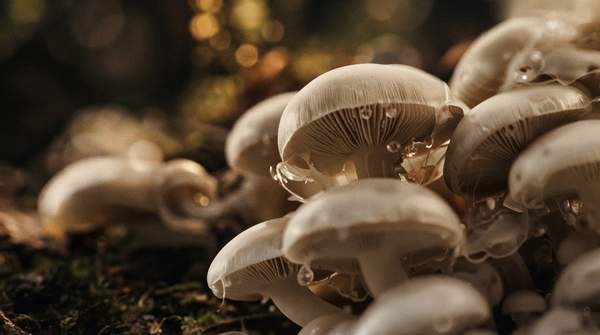
The nucleotides divide by kingdom. The Umami Information Center reports that inosinate is found primarily in meat and fish, while guanylate is more abundant in the mushroom family—dried shiitake mushrooms being a standout source. Glutamate, by contrast, is naturally present in most foods: meat, seafood, and vegetables. The Center also notes that umami levels in foods rise with maturation, citing tomatoes and cured ham as typical examples.
How Synergy Works: The Molecular Mechanism of Umami Amplification
The amplification happens at the tongue's taste receptors. The scientific literature on umami receptor mechanisms identifies the T1R1 and T1R3 receptors, which form a heterodimer—a paired receptor complex—that binds L-glutamate to initiate the umami signal. Dietitian Jacqueline B. Marcus, writing in Food Technology Magazine, adds that researchers Chaudhari and colleagues discovered an L-glutamate taste receptor, taste-mGluR4, in 2000, likening its activation to "turning a key in a lock that then starts an engine."
Here is the crucial part for cooks. As America's Test Kitchen explains, if a nucleotide is in your mouth at the same time as glutamate, the nucleotide changes the shape of the glutamate receptor, allowing it to send amplified savory signals to the brain. This allosteric effect—one molecule altering another receptor's behavior—is why a dash of each outperforms a double dose of either.
The magnitude is notably species-specific. Research on umami mechanisms reports that inosinate enhances responses to various amino acids in rodents, while in humans and dogs it enhances the response to glutamate only—and the synergism between glutamate and 5'-nucleotides, though weak in rodents, is extremely large in humans. Our palates are built for this pairing.
Umami Pairing Chart: Ingredients for Savory Synergy
Use the table below to plan pairings: pick one ingredient from the glutamate column and one from a nucleotide column. The synergy compounds across categories, so cross-category combinations deliver the amplification effect.
| Ingredient | Primary Umami Compound | Best Pairing Category |
|---|---|---|
| Tomatoes (especially mature) | Glutamate | Pair with inosinate or guanylate sources |
| Parmigiano-Reggiano | Glutamate | Pair with inosinate sources (e.g., anchovies) |
| Kombu seaweed | Glutamate | Pair with inosinate sources (e.g., bonito) |
| Meat, general | Inosinate (IMP) | Pair with glutamate sources |
| Fish, general | Inosinate (IMP) | Pair with glutamate sources |
| Bonito flakes (katsuobushi) | Inosinate (IMP) | Pair with glutamate sources (e.g., kombu) |
| Anchovies | Inosinate (IMP) | Pair with glutamate sources (e.g., Parmesan) |
| Dried shiitake mushrooms | Guanylate (GMP) | Pair with glutamate sources |
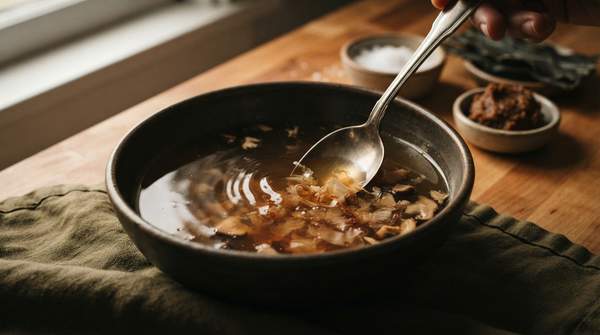
Classic dishes already embody these pairings, which is why they taste so deeply savory. America's Test Kitchen points to Japanese dashi broth, which combines glutamate-rich kombu seaweed with nucleotide-rich bonito katsuobushi; Caesar salad, which pairs nucleotide-bearing anchovies with glutamate-packed Parmigiano-Reggiano; and even the humble cheeseburger, where cheese supplies the glutamate and beef supplies the nucleotides.
Historical research supports the pattern, too. Marcus recounts that Kuninaka isolated guanosine 5'-monophosphate from shiitake broth in 1960 and discovered the synergy between glutamate and inosinate or guanylate—the scientific foundation for these culinary traditions.
Elevate Your Cooking: Intentional Umami Pairing
Home cooks should intentionally combine ingredients rich in glutamates with those rich in 5'-ribonucleotides—inosinate or guanylate—to maximize savory depth and flavor complexity in their dishes. The principle is simple: one glutamate source plus one nucleotide source, in the same dish or even the same spoonful.
The measure of success is a noticeable increase in the perceived savory, rich, and full-bodied taste of a dish after combining ingredients from different umami compound categories. A stock built on kombu alone, for instance, should taste distinctly rounder and more brothy once bonito flakes join it—and that perceptible jump is the synergy at work.
Sources
- The Science of Umami | What’s Eating Dan? — America's Test Kitchen
- Umami - Wikipedia — EN
- Umami Information by Food — Umami Information Center
- Umami the Fifth Basic Taste — PMC
- Talcottlab
- Culinary Applications of Umami — IFT