| Pici |
Tuscany |
Handmade, thick spaghetti-like strands, traditionally made with flour and water. |
Its thick, rustic texture allows it to stand up to hearty sauces. The simplicity of its ingredients complements rich flavors. |
Garlic and olive oil, or wild boar ragù. |
| Cavatelli |
Southern Italy (Molise and Puglia) |
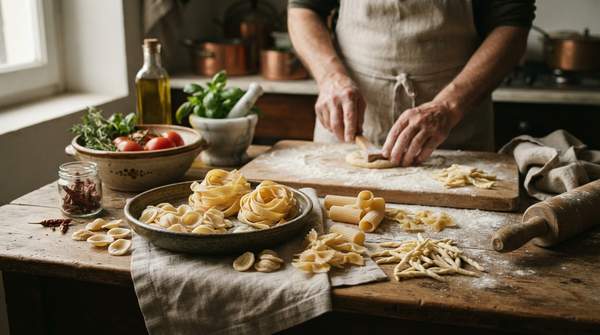
Small, rolled pasta shells with grooves and a smooth inner curve. |
The shell-like indentation and grooves are ideal for trapping chunky or smooth sauces. Its chewy texture provides satisfying bite resistance. |
Simple tomato sauces like marinara, or with sausage and greens. |
| Bigoli |
Padua (Veneto) |
Thick, tubular noodles, traditionally made using a 'bigolaro' press, sometimes with a coarse texture. |
Its substantial "hearty hold" and rough surface are excellent for picking up and clinging to rich, slippery sauces. |
Onion and anchovy sauce (bigoli in salsa). |
| Chitarra |
Abruzzo |
Square-section noodles made using a special wooden tool strung with metal wires, like a guitar. |
Its squared edges hold sauces better than round spaghetti, allowing for a more robust coating. |
Tomato sauce made with lamb. |
| Trofie |
Liguria |
Short, twisted pasta shape. |
Its twisted form is perfect for holding onto thick, emulsified sauces like pesto, which originates from the same region. |
Pesto sauce, often served with potatoes and green beans. |
| Spaghetti |
Widely popular, often associated with Southern Italy |
Long, thin, round strands. |
Its smooth surface and long length ensure every bite is perfectly coated with lighter, often oil- or tomato-based sauces. |
Tomato-based sauces like marinara or ground meat ragu, aglio e olio (garlic and oil), or seafood sauces. |
| Tagliatelle |
Emilia-Romagna (Northern Italy) |
Long, flat, ribbon-like egg pasta. |
The broad, silky surface of this egg pasta is ideal for rich, substantial sauces, allowing them to cling effectively. |
Ragù alla Bolognese, mushroom cream sauce. |
| Radiatori |
Italy |
Small pasta shapes with ridges resembling old-fashioned radiators. |
Its shape, texture, ridges, and gaps are designed to trap chunky meat and vegetable sauces perfectly, making it suitable for baked dishes. |
Chunky meat and vegetable sauces, or in baked dishes. |
| Tortellini |
Emilia region |
Small, ring-shaped pasta filled with meats and/or cheeses. |
Its delicate texture and savory filling are best highlighted by light sauces or broths that do not overpower the filling. |
In broth or with a light cream sauce. |