The secret to cooking with cheese isn't memorizing names—it's reading texture. Soft, semi-soft, firm, and hard cheeses behave very differently under heat, on a grater, or between your fingers, and that behavior traces back to moisture content. If you want a smooth sauce, a snowy grating, or distinct crumbles over a salad, start by picking the right texture category first, then choose a specific cheese from that group.
Understanding Cheese Texture for Culinary Success
Professional kitchens organize cheese by texture for a reason: it predicts performance. As the buying guides at What Chefs Want explain, chefs reach for soft and creamy cheeses for spreading and stuffing, semi-soft cheeses for melting, firm cheeses for slicing and shredding, and hard cheeses for grating and finishing. That texture, in turn, is shaped by moisture and aging.
Hard cheeses concentrate protein and lose moisture over long aging, developing the tyrosine crystals and deep umami that Kaviar Restaurants' cheese guide describes. Fresh and high-moisture cheeses sit at the other end of the spectrum, best used raw or handled carefully in heat. Keep that spectrum in mind and every choice below becomes intuitive.
The Art of Melting: Soft and Semi-Soft Cheeses
When your goal is a creamy, flowing melt—think grilled sandwiches, sauces, or a cheese pull on a burger—reach for the semi-soft and younger end of the case. What Chefs Want recommends semi-soft cheeses specifically for melting and sandwiches, and for burgers suggests American as the most reliable classic melt, with cheddar, Alpine-style cheeses, or pepper jack when you want more personality.
The Mozzarella Company's buyer's guide adds a practical pizza rule: fresh mozzarella adds creaminess but can make a pizza soggy, while low-moisture mozzarella melts evenly. Their solution is to blend—mostly low-moisture mozzarella, with fresh mozzarella added near the end of cooking so it contributes creaminess without flooding the crust.
Grating and Shaving: The Firm and Hard Cheese Advantage
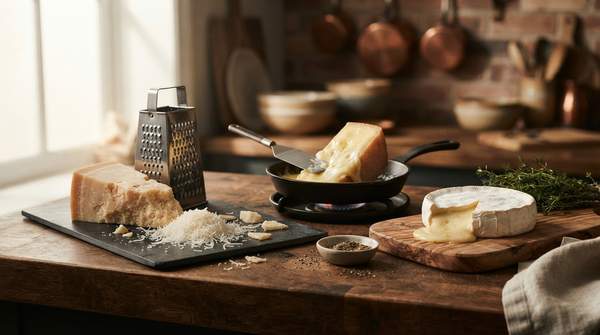
Firm cheeses earn their keep in general cooking—they hold their shape and shred cleanly, which makes them the workhorse category for everything from gratins to taco toppings. Hard cheeses play a different, more precise role: aged for months or years, they turn dry, granular, and crumbly, concentrating salt and savor into every fragment.
That's why What Chefs Want calls Italian hard cheeses like Parmigiano Reggiano, Grana Padano, and Pecorino Romano "the workhorses of professional kitchens." Grate or shave them for finishing: Kaviar Restaurants' guide pairs them with pasta and grilled meats, and What Chefs Want suggests shaving caciocavallo over grilled dishes or melting smoked scamorza over roasted vegetables when you want cheese to stand up to high heat.
Crumbling and Spreading: Fresh and Creamy Options
Not every cheese needs heat. Soft and creamy cheeses—high in moisture and often delicately structured—are at their best spread on bread, tucked into vegetables for stuffing, or set out on a cheese board where their texture can be appreciated as-is. Fresh cheeses belong in the same raw-preparation family: Kaviar Restaurants matches fresh cheeses to salads and spreads.
The Mozzarella Company's guide reinforces the general principle: match high-moisture cheeses to raw applications and firmer, aged cheeses to heat. If your crumbles are destined for a salad or a finished soup rather than the oven, a fresh or soft cheese delivers brightness and lactic tang without breaking down or weeping.
Navigating Trade-offs: Flavor, Meltability, and Moisture
Here's the tension every cook eventually hits: the cheeses with the most flavor often melt the worst. Aging concentrates taste but dries out texture, while younger, higher-moisture cheeses melt smoothly but bring less complexity. Hard cheeses compensate with crystalline crunch and savory depth that survives grating; soft cheeses trade that intensity for tenderness.
What Chefs Want applies this directly to mac and cheese, recommending a blend of a flavorful cheese—sharp cheddar, Gouda, or Gruyère—with a high-melt cheese like young cheddar or American, so you get both dimensions in one pot. The Mozzarella Company echoes the same trick for pizza with its low-moisture-plus-fresh mozzarella strategy, and notes that cooking intensifies sharp notes, so use milder cheeses when you want subtlety.
Cheese Application Decision Framework
Use this matrix to move from your recipe's goal to the right texture category and a concrete cheese to buy. Each row pairs a common cooking application with the texture that performs it best, the reason it works, and illustrative examples drawn from the culinary guides above.
| Cooking Application | Desired Outcome | Best Cheese Texture | Why It Works | Examples |
|---|---|---|---|---|
| Melting (sauces, sandwiches, burgers) | Smooth, even melt | Semi-soft; young, higher-moisture cheeses | More moisture melts readily without breaking | Low-moisture mozzarella, young cheddar, American, pepper jack |
| Grating and shaving (finishing pasta, soups, grilled dishes) | Concentrated flavor in fine flakes | Hard, long-aged | Low moisture and concentrated protein allow fine grating; tyrosine crystals add savory depth | Parmigiano Reggiano, Grana Padano, Pecorino Romano, caciocavallo |
| Slicing and shredding (everyday cooking) | Holds shape, shreds cleanly | Firm | Retains structure through cooking | Sharp cheddar, Gouda, Gruyère, Alpine-style cheeses |
| Crumbling and spreading (salads, boards, stuffing) | Distinct crumbles; spreadable texture | Soft, creamy, fresh; high-moisture | Delicate, moist structure spreads easily and crumbles cleanly when raw | Fresh mozzarella, fresh cheeses for salads, soft spreadable cheeses |
| High-heat applications (pizza, broiler) | Brown without sogginess | Low-moisture or hard | Less water released under heat | Low-moisture mozzarella, smoked scamorza |
| Complex baked dishes (mac and cheese) | Flavor and smooth texture | Blend of aged and young | Combines depth of aged with melt of young | Sharp cheddar or Gruyère plus young cheddar or American |
The framework works because texture and application are two ends of one question: how much water does this cheese hold, and where does that water go when heat, grater, or fingers get involved?
Practical Tips for Optimal Cheese Selection
Before you shop, run a quick three-step pass over your recipe: identify the application (melt, grate, crumble, or raw), pick the matching texture category from the framework, and only then choose a specific cheese within it. Reach for firm and hard cheeses when structure and concentration matter; reach for semi-soft and young cheeses when the melt is the point.
Two habits will save most dishes. First, manage moisture: keep fresh cheeses off the pizza until the end, and favor low-moisture options for anything baked until crisp. Second, when you want big flavor and a smooth texture in the same dish, blend rather than compromise—one cheese for depth, one for melt.
Selecting Your Cheese: A Confident Culinary Choice
Choose cheese based on its texture and moisture content to match your desired cooking application, prioritizing smooth melting, easy grating, or effective crumbling and spreading. The examples here are illustrative, not exhaustive—any cheese in the right category will behave similarly.
You'll know the selection worked when the dish achieves the intended cheese texture and consistency: a smooth sauce without oil separation, a crisp, concentrated grating over pasta, or distinct crumbles on a salad rather than a watery puddle. If the cheese greases out, weeps, or disappears into the dish, the texture category was wrong—step one row up or down the moisture spectrum and try again.