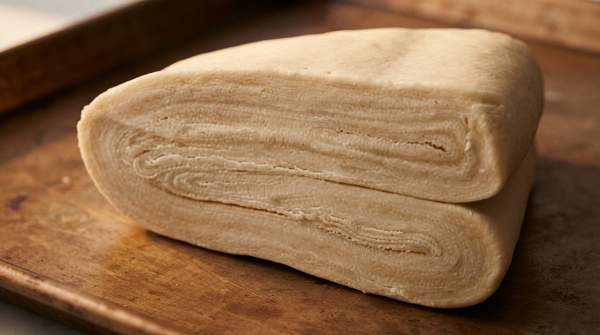
Flaky croissants and puff pastry come from one physical arrangement: thin, continuous sheets of butter trapped between thin sheets of dough. When the pastry bakes, the water in the butter and dough turns to steam, the steam pushes the layers apart, and the melted fat keeps them from fusing back together. That is the entire secret. Everything a baker does during lamination—choosing the right butter, chilling at the right moments, and choosing the right folds—serves the single goal of protecting those layers until the oven does the rest.
Pastry educators describe the process as laborious and precision-dependent, and that is honest. But precision becomes far easier when you understand what each variable actually does. This guide connects butter quality, temperature, and folding geometry so you can diagnose problems like butter leakage or a bready crumb instead of guessing at them.
The Science of Lamination: Layers of Flakiness
Lamination begins with a butter block enclosed in dough—the dough portion is traditionally called the détrempe, the butter addition the beurrage, and the combined packet the paton. The packet is rolled flat and folded repeatedly, and each cycle of rolling and folding multiplies the layers while making them thinner. Baking industry references describe how repeated sheeting and folding reduces the fat to thin films separating the dough layers.
The lift comes from two leavening systems working together. In yeast-leavened laminated doughs like croissants, yeast provides one source of rise, while the expansion of moisture and air trapped between the dough and fat layers provides the other. In puff pastry, the steam-driven expansion does nearly all the work. As one baking science writer puts it, the butter melts and the water turns to steam, "pushing against the dough layer above resulting in air pockets which create a light texture."
The key insight is that flakiness is structural, not chemical. You are not waiting for an ingredient reaction; you are building an architecture. If the layers merge, smear, or tear during rolling, no amount of oven heat will rebuild them.
Butter's Role: The Heart of Laminated Dough
Butter is the structural fat in lamination, and its quality matters because the butter must survive being rolled into a sheet thinner than a coin without breaking or liquefying. Bakers writing about croissant technique consistently recommend high-fat, European-style butter for producing an airy interior and flaky exterior. One home baker who compared Costco butter, Kerrygold, and Plugra in side-by-side croissant trials reported that Plugra won decisively—though that is one baker's reported experience, not a controlled test.
What matters most is not the brand but the behavior. The butter needs to stay one thin, continuous layer throughout the process. If it shatters into fragments, the dough layers fuse in the gaps. If it softens into the dough, the layers never form at all. Higher-fat butter is preferred for flakiness; the general principle is enough to guide a purchase without an exhaustive brand comparison.
Think of the butter block as a solid sheet of engineering material. Its job is to be plastic—bendable under the rolling pin without breaking or flowing. Everything about temperature control follows from that requirement.
Temperature Control: Mastering the Malleability
The ideal butter state is cold but plastic: firm enough to hold its shape, soft enough to stretch with the dough. Baking references recommend keeping the work environment cool—one source suggests below 65°F, another cites a bakery room temperature of 60°F (15°C) as the rule to prevent the fat from melting. Le Cordon Bleu's pastry instructors train students to feel when dough is ready for the next turn: soft enough to roll, but cold enough to prevent melting.
Both failure directions are visible at the rolling pin. Butter that is too cold becomes brittle and cracks during rolling, tearing the dough layers and sometimes sliding out of the packet entirely. Butter that is too warm melts and gets absorbed into the dough, producing greasy, dense pastries with no distinct layers—the classic butter leakage. As one croissant guide bluntly states, "Temperature is the line between crisp layers and butter leakage."
Rest periods between turns serve two purposes at once. Refrigeration lets the gluten relax so the dough rolls out instead of springing back, and it lets the butter resolidify so it stays plastic for the next turn. Skipping the rest because the dough "looks fine" is a common cause of shrinkage and greasy streaks on the next turn. One clean, well-chilled turn is worth more than two sloppy ones.
Folding Geometry: Crafting Layer Structures
Two folds dominate lamination. The three-fold, or letter fold, folds the dough into thirds like a business letter. The four-fold, or book fold—also called the double-turn method—folds both ends toward a slightly off-center meeting point, then folds the whole piece in half.
The arithmetic is simple and relentless. A single letter fold creates two fat layers between three dough layers. A single book fold creates three fat layers. Each additional turn multiplies the count: the letter fold triples the fat layers each time, while the book fold quadruples them. This is why three letter folds are commonly described as producing 27 layers of butter and dough in a croissant.
Because the two folds multiply at different rates, they are interchangeable tools with different strengths. The letter fold is gentler per turn and easier to roll evenly; the book fold builds layers faster but demands more from your rolling precision, since each turn compresses more structure into the same thickness. Bakers can mix them—one common sequence is letter, book, letter—and any combination is valid if the total layer count lands where you want it.
Lamination Layer Calculator: Designing Your Pastry's Flakiness
The table below calculates the fat layers generated by each folding method across successive turns, starting from a single butter layer locked into the dough. Use it to choose a folding strategy before you begin: pick your target structure, then work backward to a sequence of turns that produces it.
| Turns completed | Letter fold (three-fold) fat layers | Book fold (four-fold) fat layers |
|---|---|---|
| 1 | 2 | 3 |
| 2 | 6 | 12 |
| 3 | 18 | 48 |
The calculation works like this: each letter fold triples the existing fat layers (2, then 6, then 18), while each book fold quadruples them (3, then 12, then 48). A mixed sequence multiplies accordingly—one letter fold followed by two book folds yields 2 × 4 × 4 = 32 fat layers, while three letter folds yield 18 fat layers interleaved with 19 dough layers, the structure behind the commonly cited 27-layer croissant figure for three simple folds.
The comparison shows why fold choice is a design decision, not a recipe formality. Three book folds generate more than double the layers of three letter folds in the same number of turns, but each layer is correspondingly thinner and more fragile. Pastry instructors note that counting fat layers is customary practice in European bakery schools precisely because the number predicts the texture.
The Impact of Layer Count on Texture
More layers is not automatically better. Under-lamination—too few layers—produces a bready texture with thick, distinct layers, because each fat sheet is too thick to generate fine separation. Over-lamination—too many layers—pushes the sheets so thin that they merge into each other, and the pastry turns dense and cakey rather than flaky.
The commonly cited croissant standard of 27 layers of butter and dough from three simple folds represents a balance point, but the optimal count varies with the texture you want and the specifics of your recipe. Crispness and flakiness trade off along this axis: more, thinner layers lean toward delicate crispness; fewer, thicker layers lean toward a more open, flaky crumb. The evidence describes these outcomes texturally rather than by fixed numeric thresholds, so judge your own dough by its crumb, not by a number alone.
Layer thickness also depends on how thin you roll between turns. Two bakers executing identical fold sequences will produce different structures if one rolls to 4 mm and the other to 8 mm. The fold count sets the multiplication; your rolling sets the divisor.
Troubleshooting Common Lamination Problems
Most lamination failures announce themselves early, and each symptom points to a specific cause:
- Butter cracking or shattering while rolling: the butter is too cold and brittle. Let the dough rest at cool room temperature briefly until the butter is plastic again.
- Butter bulging at the edges or leaking out: the butter is too warm and melting into the dough. Stop immediately and chill the whole packet.
- Dough springing back or fighting the pin: the gluten is too tense. Refrigerate and let it relax before continuing.
- Greasy streaks in the dough: butter was absorbed during a previous turn, usually from insufficient chilling. Chill longer between turns going forward.
- Bready, dense crumb after baking: too few effective layers, or layers that merged during rolling. Check your fold count and rolling thinness.
The diagnostic principle behind all of these: the dough should lengthen with even resistance and fold back on itself without cracking at the seams. When it does not, the answer is almost always to stop and chill rather than push through. Working in a room cooler than 65°F, or running the air conditioning, buys you the working window that makes everything else possible.
Achieving Lamination Mastery: A Mindful Approach
To consistently achieve perfectly laminated dough, bakers should prioritize precise temperature control of both butter and dough, understand the geometric impact of their chosen folding method, and allow adequate rest periods to manage gluten development and butter consistency. These three levers—butter state, temperature, and fold geometry—are not independent: warm butter ruins good folding, and tense dough ruins good butter.
The measurable indicator of success is concrete: the dough rolls out smoothly without butter cracking or leaking, and the baked pastry exhibits distinct, airy layers with a balanced crisp and flaky texture. When your next batch meets that standard, you will know your lamination worked—and when it does not, the symptom itself will tell you which lever to adjust.
Sources
- Dough Lamination | Baking Process — BAKERpedia
- Laminating Croissant Dough: Get Flaky Layers Every Time — DBakerAid™
- Laminated Dough For Croissants Kouign-amann Morning Buns Cronuts — Beyond Sweet and Savory
- Blog - The Science Behind the Perfect Croissant: Why Technique Matters — Cordonbleu
- Understanding the Lamination Layer Calculation Process — Pastry Arts | Magazine, Podcast, Summit, Shop & Community