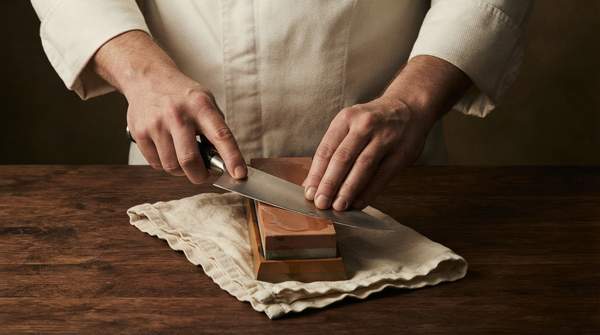
Every sharpening method—whetstone, pull-through, or electric—does the same physical job: an abrasive scrapes away tiny bits of steel until the two faces of the blade meet at a clean, thin apex. What separates a razor-sharp edge from a ruined one is not the tool's brand but three controllable variables: the size of the abrasive particles (grit), the angle at which you hold the blade, and how well the process manages heat and debris. Understand those, and choosing a method becomes straightforward.
The Science of Sharpness: How Knives Cut
A dull knife is not "smooth"—it is a blade whose apex has folded, worn, or chipped away at the microscopic level. Sharpening restores that apex by removing metal from both sides of the edge until they intersect precisely. As sharpening educator Ethan Chlebowski puts it, the fundamentals of any sharpening system come down to four things: abrasive, sharpening angle, burr, and consistency. The burr matters because it is your proof of progress: a thin flap of steel that forms along the edge when you have abraded one side all the way to the apex. Feeling for it tells you when to switch sides or move to a finer stone.