There is no single best pasta maker—there is only the best match for how you cook. If you want the lowest cost and the freedom to experiment with any dough, a hand-cranked roller is the answer. If fresh pasta is a weekly ritual and your arm tires of cranking, an integrated electric roller automates the same sheet-making process. And if penne, rigatoni, and bucatini are what you crave, you need an electric extruder, which pushes dough through shaping disks a roller simply cannot manage. Here is how the three types compare on cost, effort, shapes, dough, and cleaning.
Understanding the Main Types of Pasta Makers
Home pasta machines fall into three distinct formats, according to a pasta machine manufacturer's guide to hand-cranked versus electric models. The first is a motor attachment system: a classic manual roller fitted with a detachable plug-in motor, such as the Marcato Pastadrive, giving you manual control when you want a slow, quiet roll and motor assistance for larger batches. The second is the integrated roller-and-cutter machine, an all-in-one motorized unit with built-in rollers and dual cutting blades—since you never turn a handle, both hands stay free to guide long sheets.
The third is the extruder. As the pasta equipment site Lineapasta explains, extruders work by forcing dough through a die whose shape determines the pasta—spaghetti, maccheroni, tagliatelle, and more. Hand versions drive the dough with a crank-turned screw mechanism; modern electric extruders replace manual force with a motor, making the process faster, continuous, and less strenuous. Food Network Kitchen, which tested both manual and electric models with eggless, egg-enriched, and even cracker doughs, treats this manual-versus-electric choice as the first decision any buyer must make.
Manual Rollers: The Traditional Choice
A manual roller is a hand-cranked machine that flattens dough into thin sheets, which you then cut into lasagna, fettuccine, tagliolini, or ravioli. Specific shapes beyond sheets require additional cutting attachments or work. Food Network Kitchen named the Marcato Atlas 150 its best overall pasta maker, and the machine's core appeal is control: you set the pace and the thickness.
The standout advantage is dough flexibility. In testing, Food Network Kitchen found that "manual pasta machines work well with just about any dough recipe, while electric pasta machines perform best when using the dough recipes provided by the manufacturer." That freedom matters if you like experimenting with hydration, flours, or enriched doughs. The trade-off is effort—every sheet depends on your cranking—and cleaning. Bon Appétit's testing of a Marcato roller machine found you must let dough fully dry, then scrape away remnants with a small brush, keeping water away from the machine entirely.
Integrated Electric Rollers: Automated Sheet Making
An integrated electric roller is simply the manual concept with the crank removed. Bon Appétit's top overall pick, the Marcato Atlasmotor, rolls tagliolini, fettuccine, and lasagna sheets without needing a free hand to crank, and it eliminates the counter clamp that manual models require. The magazine flagged one clear drawback: at a list price of $330, it is pricey compared with crank models.
The manufacturer's comparison guide adds practical cautions for any motorized roller: a constant buzzing hum during operation, motors and switches that can wear over time, and cleaning that demands care around electrical components. The payoff is time. The same guide estimates that a household serving pasta weekly saves fifteen to twenty minutes per session, which compounds over a year. This is the machine for frequent pasta makers who still want flat, sheet-based pasta and some control over their dough, but no longer want to earn it by hand.
Electric Extruders: For Diverse Shapes and Convenience
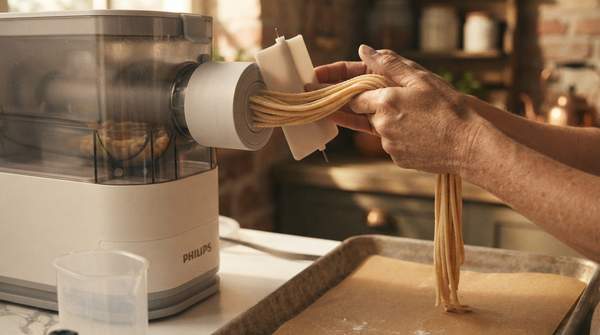
An extruder is the only type of the three that produces shaped pasta. Bon Appétit describes the mechanism plainly: an auger tool pushes dough through interchangeable shaping disks, much like a Play-Doh toy. If you like rigatoni or bucatini—"another shape of pasta that a pasta roller machine won't be able to manage," as the magazine puts it—an extruder is your category.
Bon Appétit's pick, the Philips 7000 Series, lists at $380 and produces spaghetti, fettuccine, penne, lasagna, angel hair, and thick spaghetti from its included disks. It goes further than rolling: you pour ingredients into its top-loaded container, the machine kneads the dough for you, and a countdown display tells you when pasta will start emerging from the disk—minimizing countertop mess and removing a labor-intensive step. The magazine found it easy to clean, though heavy at 15 pounds 3 ounces, and noted it does not cut the pasta for you. The constraint is dough: as Food Network Kitchen's testing showed, electric machines perform best with manufacturer-provided recipes, so improvisation is off the menu.
Pasta Maker Decision Matrix
The table below compares the three types across the factors that drive the decision. Prices are the list prices of the specific models each publication tested; sale prices were observed lower at several retailers.
| Dimension | Manual Roller | Integrated Electric Roller | Electric Extruder |
|---|---|---|---|
| How it works | Hand-cranked machine rolls dough into sheets | Motorized unit rolls and cuts sheets automatically | Motor-driven auger pushes dough through shaping disks |
| Typical cost | Affordable | $330 list (Marcato Atlasmotor) | $380 list (Philips 7000 Series) |
| Effort | Requires manual cranking for every sheet | Both hands free; no crank or counter clamp needed | Machine kneads and extrudes; you pour in ingredients |
| Pasta shapes | Flat sheets: lasagna, fettuccine, tagliolini, ravioli (cutting required) | Tagliolini, fettuccine, lasagna | Spaghetti, fettuccine, penne, lasagna, angel hair, thick spaghetti |
| Dough versatility | Works with just about any dough recipe | Roller design allows dough control, though electric machines generally do best with manufacturer recipes | Best with manufacturer-provided dough recipes |
| Cleaning | Let dough dry, brush away remnants, avoid water | Brush method plus care around electrical components | Reported easy to clean (Philips 7000, per Bon Appétit testing) |
| Best for | Occasional hobbyists and those who enjoy the traditional, hands-on process | Frequent pasta makers who want to automate rolling but still prefer flat pasta | Those prioritizing speed, convenience, and diverse shapes |
Read the matrix by matching your top priority to the row where the types diverge most. Dough freedom points to a manual roller; shape variety points only to an extruder; the electric roller wins on automating a process you already love.
Making Your Choice: A Pasta Maker for Every Cook
Choose a pasta maker type based on your budget, desired pasta shapes, tolerance for manual effort, and frequency of use. The occasional hobbyist who savors the process—and wants freedom over dough recipes—belongs at a manual roller. The weekly pasta maker who still wants sheets and control, but not the crank, belongs at an integrated electric roller. The cook who wants penne on the table with minimal effort belongs at an electric extruder, provided they follow the manufacturer's dough guidelines.
The success measure for this decision is simple: the reader can confidently identify which of the three pasta maker types (manual roller, integrated electric roller, or electric extruder) aligns best with their cooking habits and preferences. If you can name your type—and the shape you'll make first—you've chosen well.
Sources
- Hand Cranked vs Electric Pasta Machine:Which One Is Better for Homemade Pasta? (2026 Guide) — Zhuoheng Extruder Machine
- Pasta maker — Lineapasta
- 5 Best Pasta Makers of 2026, Tested and Reviewed — Food Network
- The Best Pasta Makers for Enjoying Restaurant-Worthy Noodles at Home — Bon Appétit