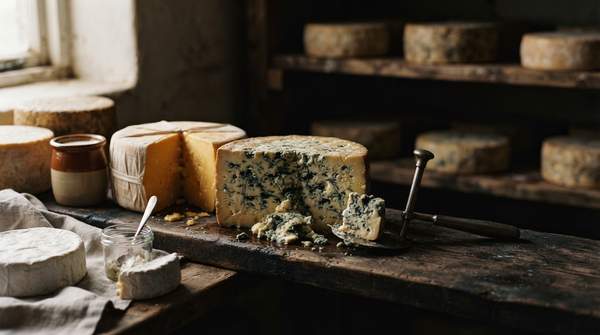
Every distinctive cheese you love is the product of a controlled microbial performance. The buttery note in Gouda, the nutty sweetness of Emmental, the piquant bite of Roquefort, the creamy collapse of a ripe Camembert—each traces back to named bacteria and fungi carrying out specific biochemical work. Understanding which microbe does what turns the "art" of cheesemaking into readable science, and it explains why cheesemakers choose their cultures as deliberately as a composer chooses instruments.
The Microbial Maestros of Cheese
Cheese is essentially milk that has been steered through fermentation and ripening by deliberately chosen microbes. Most modern cheesemakers use selected starter cultures isolated from traditional cheese production, a practice documented in the scientific literature on lactic acid bacteria in raw-milk cheeses. The choice is not casual: which microbes actually thrive during ripening depends on their ability to survive heat and acidity, to grow on energy sources other than the carbohydrates naturally present in milk, and to grow in and tolerate the low water activity inside a maturing wheel.
That last condition deserves emphasis, because it explains the drama of ripening. As a cheese ages, its environment becomes progressively more hostile—saltier, more acidic, drier—and only microbes equipped for those conditions persist. The scientific review describes the microbial sequence during ripening as related to each population's ability to adapt to the specific environmental conditions that prevail in cheese. Populations succeed one another as the wheel changes around them.
This is why flavor and texture develop in stages rather than all at once, and why cheesemakers think in terms of a cast of characters with different jobs at different moments. The acid producers go first; the ripeners and surface colonizers follow. Milk quality matters too: the review notes that toxic residues and contaminants affect milk's suitability for cheesemaking and the safety of the final product, since lactic acid bacteria need clean milk to grow well.
Starter Cultures: The Foundation of Fermentation
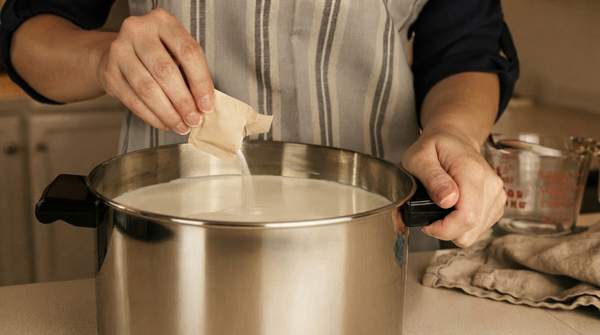
The first act belongs to the starter cultures—lactic acid bacteria whose primary job is acidification. They ferment lactose, milk's sugar, into lactic acid, which acidifies the milk and drives the formation of curd. This acid production is the foundational step on which everything else is built. Without it, there is no cheese to ripen.
Starters come in two practical families, distinguished by the temperatures at which they work. Mesophilic cultures such as Lactococcus lactis subsp. lactis produce acid at moderate temperatures, roughly 20–30°C, making them the workhorses of everyday cheesemaking. Thermophilic cultures such as Streptococcus thermophilus operate at higher temperatures around 45°C, producing acid and aiding texture in cheeses like Parmesan and Mozzarella that are made warm.
The distinction is practical, not academic: a cheesemaker cooking curd at high temperatures needs bacteria that will not be killed by the heat, while a gentle, low-temperature make calls for strains that thrive in that cooler window. A cheesemaking reference guide notes that once a maker is comfortable with the process, they can begin picking and choosing individual bacterial strains to introduce for fine-tuned results. In other words, the starter is not a single fixed recipe but a palette.
Secondary and Ripening Cultures: Crafting Complex Flavors and Textures
If starters lay the foundation, secondary and ripening cultures build the house. Secondary cultures—various Lactobacillus species such as L. helveticus, L. delbrueckii subsp. bulgaricus, and L. casei—are used in Swiss, Parmesan, and aged cheeses for flavor enhancement, proteolysis, and secondary fermentation. The scientific review describes this secondary microbiota as the community that contributes to the maturation of cheese and influences the texture, flavor, and aroma of the final product.
Ripening and specialty cultures are then added to create distinct flavors, textures, or visual characteristics in specific cheese types. Leuconostoc mesenteroides, used in Gouda and Edam, produces carbon dioxide and diacetyl, contributing to eye formation and buttery flavors. Propionibacterium freudenreichii does similar work in Swiss and Emmental, producing carbon dioxide for the characteristic eyes and nutty flavors. The fungi Penicillium roqueforti and Penicillium camemberti handle blue cheeses and surface-ripened cheeses like Brie and Camembert respectively, while Brevibacterium linens ripens washed-rind cheeses such as Limburger and Munster.
Notice the division of labor. The starter's job is largely finished early; the secondary and ripening cultures do the slow work that unfolds over weeks or months. Gas producers sculpt texture from the inside, molds colonize surfaces or veins, and bacteria digest the curd's proteins and fats into the compounds we perceive as flavor. Each is chosen for a specific, predictable effect.
The Science of Flavor: Proteolysis and Lipolysis
Two biochemical processes underpin nearly all of this flavor development. Proteolysis is the breakdown of milk proteins into smaller peptides and amino acids, which contribute flavor directly and serve as building blocks for further aromatic compounds. Lipolysis is the breakdown of milk fats into free fatty acids, which carry sharp, piquant, and characteristic notes—especially prominent in blue cheeses.
These processes are driven by microbial enzymes working slowly during ripening. The secondary microbiota's contribution to maturation—its influence on texture, flavor, and aroma—is the result of this sustained enzymatic digestion of the curd's proteins and fats. When a Lactobacillus species performs proteolysis in an aged cheese, or a surface mold breaks down fats in a ripening wheel, the sensory outcome is chemistry you can taste.
Preservation happens alongside flavor development. Lactic acid bacteria produce primary metabolites such as lactic and acetic acids, hydrogen peroxide, and bacteriocins, which give the cheese its preservative effect while the slower flavor chemistry unfolds. The same scientific review notes that recent high-throughput sequencing studies have improved knowledge of traditional cheese microbiota, which may result in improved starter cultures and cheesemaking practices that produce more consistent, higher-quality cheeses.
Microbes and Their Masterpieces: An Explanatory Model
The table below maps each key microbe to the cheeses it shapes, the biochemical action it performs, and the sensory outcome you experience in the finished wheel. Read a row left to right and you can trace the full causal chain from organism to flavor on the palate.
| Microbe / Fungus | Cheese Type(s) | Biochemical Action | Resulting Flavor / Texture |
|---|---|---|---|
| Lactococcus lactis subsp. lactis (mesophilic starter) | General cheesemaking | Ferments lactose into lactic acid at 20–30°C | Initial acidification and curd formation—the foundational step |
| Streptococcus thermophilus (thermophilic starter) | Parmesan, Mozzarella, other high-temperature cheeses | Produces acid at around 45°C and aids texture | Acidification in warm-made cheeses; texture support |
| Lactobacillus species (L. helveticus, L. delbrueckii subsp. bulgaricus, L. casei) | Swiss, Parmesan, aged cheeses | Proteolysis and secondary fermentation | Flavor enhancement and ripening complexity |
| Leuconostoc mesenteroides | Gouda, Edam | Produces carbon dioxide and diacetyl | Eye formation and buttery flavors |
| Propionibacterium freudenreichii | Swiss, Emmental | Produces carbon dioxide; contributes to flavor development | The signature eyes and nutty flavors |
| Penicillium roqueforti | Blue cheeses such as Roquefort | Molds the cheese interior; enzymatic ripening | Sharp, piquant, spicy blue flavor |
| Penicillium camemberti | Surface-ripened cheeses such as Brie and Camembert | Colonizes and ripens the surface | Earthy, mushroomy flavors and creamy texture |
| Brevibacterium linens | Washed-rind cheeses such as Limburger and Munster | Surface ripening through proteolysis and lipolysis | Distinctive ripened flavor and rind character |
The pattern across the rows is the point: different microbes perform distinct biochemical actions, and those actions—not the milk alone—produce each variety's unique profile. Gas production creates structure; enzymatic breakdown creates flavor; surface colonization creates rind and aroma.
Commercial culture suppliers illustrate how precisely these profiles can be targeted. Novonesis, a biosolutions company, markets blends such as a Camembert culture said to add sulfur and garlic notes along with brownish striations, and a surface-ripening range that supports the microbial activity behind Camembert's characteristic mushroom-like, earthy flavor and surface appearance. These are supplier descriptions of designed products, not independent test results, but they show the same principle at work: specific cultures are chosen to deliver specific, predictable sensory outcomes.
Cheesemakers' Art: Guiding Microbial Action for Distinctive Cheeses
Cheesemakers strategically select and manage specific microbial cultures to control biochemical processes, thereby developing desired flavor and texture profiles in artisanal cheeses. The starter culture acidifies; the secondary and ripening cultures then do the slow work of proteolysis, lipolysis, gas production, and surface colonization that turns a bland curd into Emmental, Roquefort, or Camembert. The scientific literature's own aspiration—more consistent, higher-quality cheeses through better-understood microbiota—points to how success is judged: the consistent production of cheeses with specific, reproducible flavor and texture characteristics indicates successful microbial management. When a wheel of Emmental reliably shows its eyes and nutty character, or a Camembert its earthy creaminess, the microbes have done exactly what they were chosen to do.