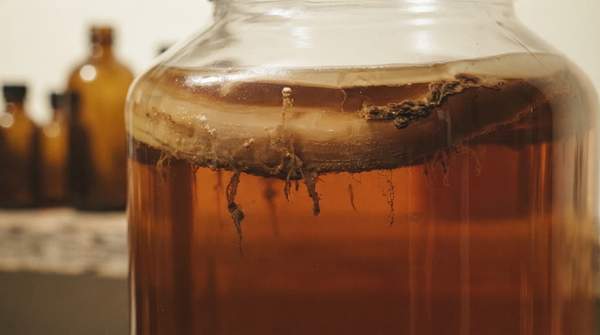
Kombucha and water kefir taste distinctly different because they are built by two fundamentally different microbial teams. Kombucha's SCOBY is dominated by acetic acid bacteria—genera such as Komagataeibacter, Acetobacter, and Gluconacetobacter—that turn a sweetened tea base into a tangy, vinegar-like drink. Water kefir, by contrast, is driven by lactic acid bacteria, chiefly Lactobacillus and Leuconostoc, working with yeasts like Saccharomyces in sugar water, yielding a milder, subtly sour beverage. Same broad idea—symbiotic cultures of bacteria and yeast—but two entirely different metabolic logics.
The Fermentation Fundamentals: Kombucha vs. Water Kefir
Both drinks are the work of a "living factory": a partnership in which yeasts process sugars and bacteria convert the resulting compounds into acids and other byproducts. Yet the partnership is organized differently in each case. A kombucha SCOBY is dominated by acetic acid bacteria that produce acetic acid and even build the culture's cellulose structure, while tibicos—the small translucent grains used for water kefir—are dominated by lactic bacteria held together in a polysaccharide matrix.
Scale matters too. The composition of each drink's microbiota is not fixed; a review comparing kombucha and kefir microbiomes notes that the exact communities depend on the starter culture's origin, growth conditions, processing techniques, and substrate, with the origin of the starter culture playing "one of the most crucial roles" in which strains dominate. One kombucha producer's explainer sums up the practical contrast: kombucha is a longer fermentation based on tea, while water kefir is a shorter one—24 to 48 hours—based on sweetened water, often with dried fruits such as figs or raisins.
Kombucha's Tangy Profile: The Acetic Acid Pathway
Kombucha's character flows from a two-step relay. Yeasts in the SCOBY—including Saccharomyces, Brettanomyces, and Zygosaccharomyces—consume the sugars in the sweetened tea and produce ethanol. The acetic acid bacteria then take center stage: they convert that alcohol into acetic acid, the same molecule that gives vinegar its bite. As the Smile Kombucha explainer puts it, "The acetic bacteria lead the way: they produce acetic acid, build the SCOBY's cellulose, and give the drink its characteristic tangy profile."
This is why kombucha's flavor is unmistakably sharp. The dominant genera named—Komagataeibacter, Acetobacter, and Gluconacetobacter—are acetic acid specialists, and their metabolic output defines the beverage. It is a fermentation built around alcohol production by yeast followed by oxidation by bacteria, a sequence closer in spirit to how vinegar is made than to how most lactic ferments work.
Water Kefir's Milder Character: The Lactic Acid Logic
Water kefir runs on a different engine. Its tibicos grains are dominated by lactic acid bacteria: a Cosmos Society article by Denis Pashkov reports the grains contain roughly 70% lactobacilli, 10% leuconostocs, 10% acetobacteria, and 5% bifidobacteria, with the remainder made up of other genera. Lactic acid fermentation is described as the most significant metabolic process during water kefir fermentation, which directly explains the drink's milder, more subtle sourness compared with kombucha's vinegar edge.
The yeasts are active partners here too. Saccharomyces cerevisiae—which Pashkov notes is always present—along with Candida, Hanseniaspora, and Guehomyces ferment sugars and interact with the bacteria. A PubMed-indexed study of water kefir's microbial ecology describes it as "a mildly sour and alcoholic drink fermented by a stable microbial multispecies community," in which well-adapted yeasts and lactobacilli mutually provide essential nutrients in a demanding, high-sugar, low-amino-acid habitat. Some lactobacilli, such as Lactobacillus hilgardii and Lactobacillus nagelii, even produce exopolysaccharides that build the grains themselves. Notably, water kefir fermentation can involve lactic, alcoholic, and acetic acid processes together—but lactic acid is the defining output.
Kombucha vs. Water Kefir: A Microbial Comparison
The table below contrasts the two beverages across five dimensions—substrate, dominant bacteria, dominant yeast, primary acid, and flavor—tracing each characteristic back to the evidence on microbial composition and metabolism. Reading across the rows shows why the tangy and the mild diverge so clearly.
| Dimension | Kombucha | Water Kefir |
|---|---|---|
| Primary substrate | Sweetened tea | Sugar-water solution (often sucrose), sometimes with dried fruit |
| Dominant bacteria | Acetic acid bacteria: Komagataeibacter, Acetobacter, Gluconacetobacter | Lactic acid bacteria: predominantly Lactobacillus (about 70% of grain bacteria), plus Leuconostoc, Acetobacter, and Bifidobacteria |
| Dominant yeast | Saccharomyces, Brettanomyces, Zygosaccharomyces | Saccharomyces cerevisiae (always present), Candida, plus Hanseniaspora and Guehomyces |
| Primary acid produced | Acetic acid | Lactic acid |
| Resulting flavor profile | Tangy, vinegar-like | Milder, subtly sour, often lightly fizzy |
Two caveats keep this comparison honest. First, the kombucha–kefir review stresses that microbiota vary with starter culture origin, conditions, and processing, so specific strains differ from brew to brew even when the dominant genera hold. Second, water kefir grains do include some acetobacteria alongside the lactic majority—this is a matter of dominance, not exclusivity, just as kombucha contains yeasts that shape its aroma beyond the acetic core.
Understanding Your Fermentation: Choosing Your Flavor Journey
To achieve a specific flavor profile, fermentation enthusiasts should select their beverage based on the desired dominant acid and microbial community: acetic acid for tanginess (kombucha) or lactic acid for mildness (water kefir). If you want a sharp, vinegar-adjacent drink from a tea base, the acetic acid bacteria in a SCOBY will deliver it. If you prefer a softer sourness from a quicker sugar-water ferment, tibicos grains with their lactic acid bacteria are the better match—and note that the two cultures are adapted to different substrates and cannot simply be interchanged.
The taste of the final fermented beverage (tangy/vinegar-like vs. mildly sour/sweet) directly reflects the dominant microbial activity and acid production, making your palate the simplest indicator of which microbial team did the work. And because the microbiome comparison shows that starter culture origin and conditions shape which strains dominate, a brewer's observable next milestone is simply tasting successive batches: as the community settles into a given substrate, the acetic or lactic character should become a stable, recognizable signature of the culture in hand.
Sources
- Smile Kombucha - Blog - Are kombucha and water kefir the same thing? — Smilekombucha
- Metabolic activity and symbiotic interactions of lactic acid bacteria and yeasts isolated from water kefir - PubMed
- Fermented Beverage Benefits: A Comprehensive Review and Comparison of Kombucha and Kefir Microbiome - PMC
- Water Kefir: A Sparkling Ferment — COSMOS Society