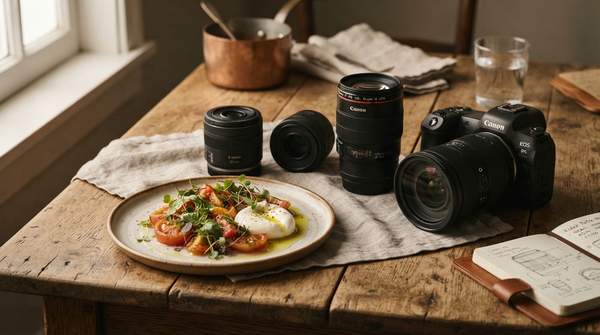
Food photographers converge on a short list of focal lengths for good reason. A 50mm prime handles flat lays, straight-on shots and 45-degree angles; a 100/105mm macro captures texture close-ups and intimate detail; a 24-70mm zoom buys versatility on set. Rachel Korinek, writing for Two Loves Studio, names the 50mm and the 100/105mm macro as the top two picks for full-frame food work, praising their combination of focal length, large apertures for low light, and a generous minimum focusing distance for close-up texture. The right choice for you depends on your shooting style, your budget, and — above all — the sensor inside your camera.
Understanding Essential Food Photography Lenses
Two broad families dominate food photography kits, and understanding their core character is the first step in any purchase decision. Prime lenses are fixed at one focal length, which means you zoom with your feet — moving closer or farther to change framing. Zoom lenses cover a range of focal lengths, letting you reframe without touching your setup. Each family carries a real cost: money and convenience on one side, optical performance and aperture on the other.
Christina Peters, a food photographer writing on the Food Photography Blog, puts the trade-off bluntly: "zoom lenses will never be as sharp (in focus) as a prime (fixed) lens." Her comparison piece also highlights that lens grades matter within those families — every manufacturer makes both consumer-grade and professional-grade lenses, and the pro versions cost considerably more. So a decision about lens type is also a decision about how much optical quality you're willing to pay for within that type.
Within these families, four specific lenses recur across independent recommendations. Regan Baroni, a Nikon shooter, lists the 50mm f/1.8, the 105mm f/2.8 macro and the 24-70mm f/2.8 zoom among her core food photography lenses, alongside a 14-24mm wide angle for location work. Korinek adds that macro capability matters regardless of camera type, because a macro lens lets you "go beyond overhead food photography shots," capture up-close details of texture, and gain more control over minimum focusing distance. David Schloss, writing at Imaging Resource, rounds out the picture with focal-length guidance: wider lengths like 35mm excel for overhead flat lays and environmental context shots, 50-85mm focal lengths work beautifully for 45-degree angles and intimate detail, and macro lenses in the 90-105mm range provide a comfortable working distance for extreme close-ups "without casting lens shadows on subjects."
Notice what that last point implies for styling. A macro lens in the 90-105mm range doesn't just magnify — its longer focal length lets you shoot from farther back, which keeps the physical lens out of the light path when you're working inches from a plate with off-camera flashes or window light. That working distance is a practical, on-set advantage that pure magnification numbers don't capture, and it's one reason macro primes earn a permanent spot in so many food kits.